
 Skip to content
FOR SALONS, STYLISTS & HAIR BRANDS
PLUCHARM / PROFESSIONAL BUYING GUIDE
A colour that matches under a lamp still shows when the hair moves, because the eye reads the gradient from root to tip, not a single flat tone. Blend comes from ordering two or three adjacent tones, keeping a darker root shadow, and accepting that dyed-to-order hair will never be a pixel copy of a client’s lengths.
Natural hair is not one colour. Even a client who describes herself as dark brown has a lighter band where the sun hits, a darker band at the nape, and a root that is cooler than the lengths. When you match the lengths exactly with a single tone, the extensions become the only flat area on the head, and flat reads as artificial no matter how close the shade is.
The second cause is finish. Salon-coloured natural hair carries a slight sheen that is directional, while a new extension batch reflects light more evenly. Under daylight the two surfaces read differently even when a colourimeter says they match, because the eye is reading reflectance, not pigment.
This is why colour conversations that start with a code and end with a code tend to disappoint. The code describes pigment. The client is looking at movement, shadow and light.
Before selecting, photograph the client’s hair in daylight with the camera at the same height as the mid-lengths. Then read three points: the root, the mid-length, and the last 10 cm. Most clients need a root tone one level darker than the mid-length, and a tip tone half a level lighter, and those three readings are what the order should be built from.
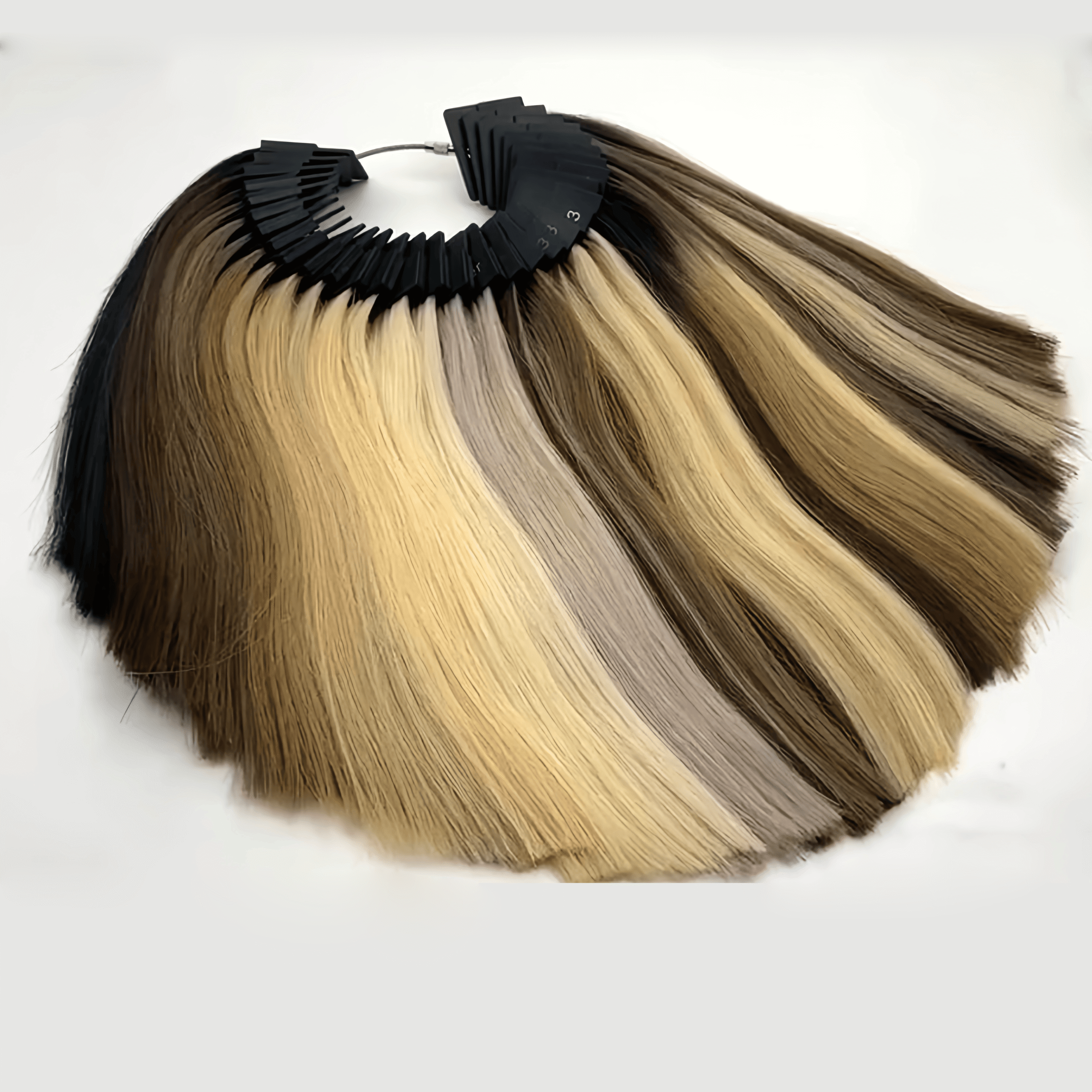
Note the direction as well as the level. Two clients at level 7 can sit at opposite ends of warm and cool, and a cool ash placed on a warm level 7 will look grey rather than blended. Direction is the part of colour that photographs badly and shows in person, which is why every custom order at PLUCHARM is confirmed against a physical colour ring rather than a screen.
For most blended installs, order the majority of the weight in the mid-tone, about a quarter in the darker root tone, and the remainder in a lighter tone for the face frame and the last few rows. Place the darker tone in the top rows where a root shadow is natural, and the lighter tone at the front and the ends where light actually falls.
This is also how density is controlled without adding weight. A mixed row reads fuller than a flat row of the same grams, because the eye separates the tones and stops seeing a single mass. Clients who describe their own hair as flat usually respond better to a two-tone build than to a heavier one.
Record the mix as a ratio on the client card, for example two thirds mid, one quarter root, the remainder light. A ratio survives a colour code change; a code does not survive a tone change.
Custom dye can hit a target tone, build a gradient, and match a physical swatch within a normal tolerance. It cannot make new hair behave like five-year-old hair, and it cannot guarantee a match to a screen image. Lighting, white balance and monitor calibration move a photograph by more than most people expect.
It also has a lead time, because dyeing is a batch process rather than a stock pick. Plan custom colours into the booking rather than ordering them the week of the fitting, and keep a small stock of the client’s ratio once it is approved so the first reorder does not repeat the sampling cost.
Be direct about the limits: if a client’s lengths are faded in a way she likes, the honest answer is that the extension batch will be more even, and the blend will be built by mixing tones rather than by reproducing the fade.
Order a single row in the intended ratio and fit it where the seam will least show. Then check it in three conditions: daylight at a window, warm interior light, and the client’s own bathroom. Most colour complaints are lighting complaints, and they can be resolved before the full order ships.
If the test row reads too cool, the correction is usually one tone warmer in the mid-length rather than a lighter root. If it reads too flat, add the lighter tone at the face frame before changing the base. Both changes are cheaper than replacing a full set, and both are visible in a single row.
Every dye batch differs slightly, which is why the approved swatch matters more than the code. Keep the physical sample with the client record, note the batch reference, and check the new delivery against the sample under daylight before the fitting, not in the chair with the client waiting.
Colour is the part of the specification most likely to be described in words that mean different things to different people. Warm, ash, honey and natural are not measurements. A level, a direction and a physical sample are, and they are what make the second order look like the first.
Editorial update: 7 November 2026. Colour practice and PLUCHARM production limits described here reflect our own dye and sampling process; confirm the specification for your order.
For buyers sourcing at volume, this topic sits alongside the practical detail on our wholesale hair extensions page: the thirteen methods we manufacture, trade pricing and minimum order.