
 Skip to content
FOR SALONS, STYLISTS & HAIR BRANDS
PLUCHARM / PROFESSIONAL BUYING GUIDE
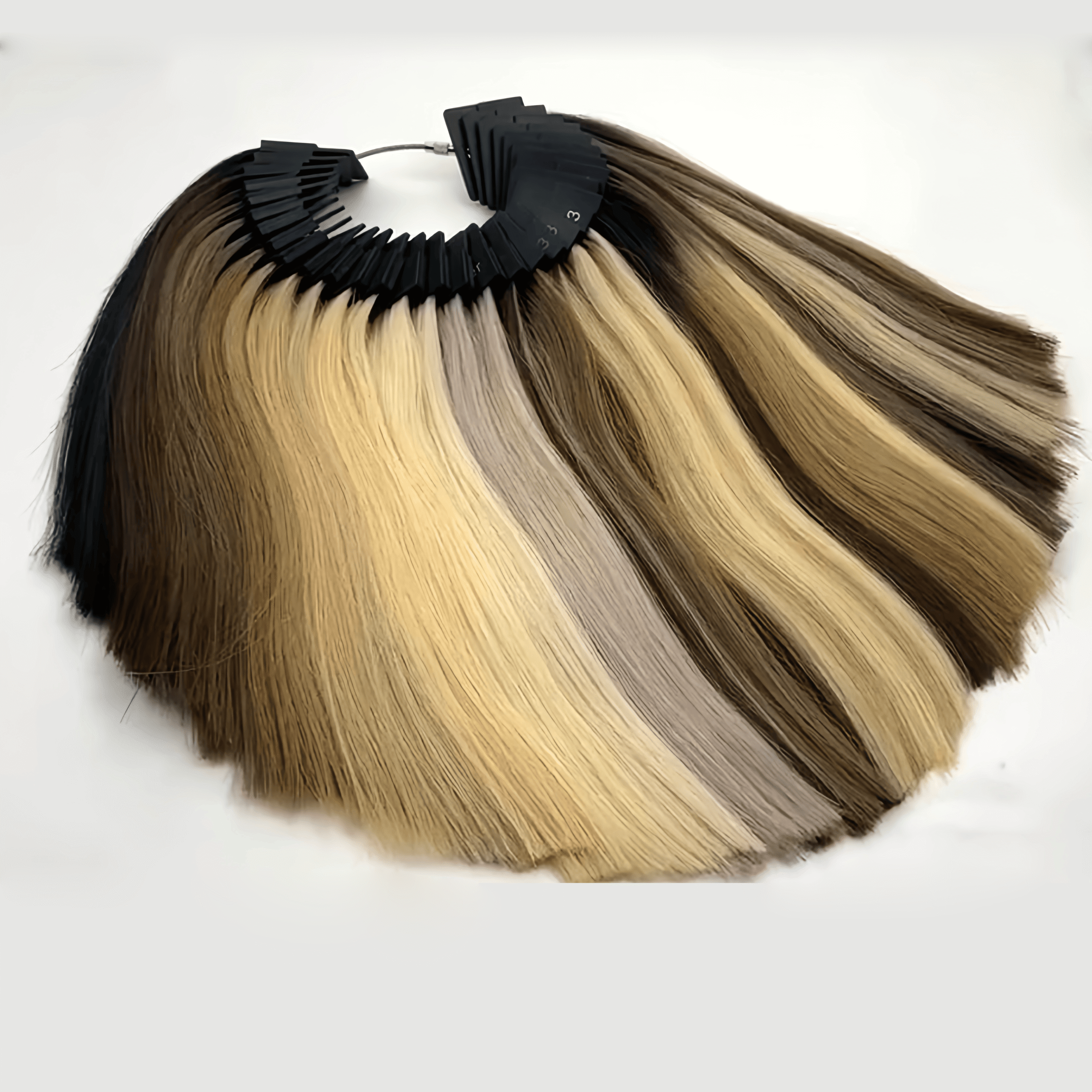
A colour library is a range of references, not a stock position. Twenty-six shades across four lengths and thirteen methods is 1,352 combinations, and depth — not breadth — decides whether your client gets the tone you sold her. Here is what to ask, and why the answer matters more than the shade card.
Before you commit a season of restocking to a colour library, ask your supplier one question the shade card cannot answer: how deep are you holding, in this exact shade, in this length, right now?
Not “do you have 26 shades.” How many of those exist in more than a single pack, at the two lengths you actually install.
Then ask two more and you have most of a supply plan. Which pack carries a batch reference a buyer can read. And what happens to your order when the shade you need is short next month — split shipment, dated backorder, or a suggestion that the neighbouring tone is close enough.
Most salons buy colour from a photograph and a promise, then discover the depth question the first time a reorder comes back different.
A colour library is presented as a number. Twenty-six shades. It reads like a range of choices, and it is also a count of the ways one order can arrive incomplete.
Twenty-six shades across four lengths and thirteen methods is 1,352 distinct combinations. Those are our own published figures: 26 references, 18, 20, 22 and 24 inch, thirteen methods built on one quality standard. The multiplication is not a criticism of a wide catalogue; it is the reason depth is expensive for anyone who carries one. Every combination is a position. Every position you stock is money sitting in a bag, in a shade that may or may not be moving this month.
A shade reference and a stocked shade are two different assets. One is a standard you measure against. The other is inventory. Owners of the first are not necessarily holders of the second, and the colour card does not distinguish between them.
Holding 26 references is a design task. You photograph your own stock rather than render swatches, you keep physical references on the bench, you compare each batch against them, and a batch that does not read true against its reference does not become that shade. That is a standard, and it is repeatable.
Holding depth across 1,352 positions is a working-capital task. You cannot do it evenly, so you bias toward the shades and lengths that move fastest. That is how a library ends up wide at the edges and thin where the demand is.
I have no survey of how the trade allocates stock, and I will not invent a percentage. What follows is reasoning from how a workshop is run, and you should read it as an argument you can check, not a measured fact.
Two things follow, and both are checkable without trusting me. First, the shades with the widest appeal are the ones most likely to be short at short notice, because everyone’s restocking lands on the same few positions. Second, the format and length you want can be in stock in one shade and absent in another — so “in stock” is never a property of a product, only of a combination.
Depth problems surface at the chair, in four predictable places.
The substitution conversation. The shade you ordered is short; you are offered the adjacent tone. Sometimes it is genuinely indistinguishable on the client. Sometimes it is two shades off and you find out under daylight. The decision gets made by whoever is holding the phone, not by the person who sold the colour, and the client is the one who notices.
The mid-season reorder. You buy across a palette in spring and one or two shades outrun the rest by midsummer. Restocking only the fast movers is where a batch change becomes visible: same shade code, new production run, and a tone that is a small but real step away from what is already on the shelf.
Two clients who must match. Mother and daughter, bridal party, a colour correction across two heads on the same day. If the two sets come from different batches, the difference is not a defect and no one will accept it as a claim. It is only avoidable by drawing from one batch, which requires knowing the batch exists.
The split set. A 100 g set often does not go to one head. Shorter installations use part of it, and the remainder becomes next month’s work — by which point it is the only survivor of its batch, with nothing left to compare it against.
None of these is dramatic; they are the friction of a natural material with a coded label.
Every reference on our site is a photograph of the shade rather than a rendered swatch, and we state plainly that screens and lighting change colour. A reference narrows the field. It does not guarantee the bundle in your hand.
We publish typical lead times by method — 5–10 days for in-stock tape and machine wefts, 7–12 days for hand-tied wefts and strand methods, longer for moulded or fully custom work. What we do not publish is depth: how many 100 g sets of this exact shade, in this exact length and method, are on the shelf today. Our own site puts it plainly: availability is checked for the complete specification. That leaves you a lead time and no depth figure, so the number has to be asked for per order, and held to.
Our return window is narrower than most buyers expect on first reading, and it matters most in exactly this case. A quality issue has to be reported within 7 days of the delivery date recorded by the carrier, and once hair has been installed, cut, coloured, washed or heat-treated it can no longer be assessed against the specification it was supplied to. A colour mismatch that only appears under salon lighting at installation lands on the wrong side of both conditions. I am not going to dress that up: the policy does not protect the failure that colour most often produces. It is written that way because altered hair cannot be assessed or resold, which is an explanation rather than a defence. Practically, it means a shade dispute has to be settled before the hair goes on a head, or it has to be settled as a favour.
Custom colour sits outside all of this. Anything off the 26 references is quoted per brief, made to order, and not returnable for change of mind. That is fair, but it means an off-ring request is a commitment, not an experiment.
The author is a partner at PLUCHARM, a hair extension manufacturer in Juancheng, Shandong, China, which sells to salons and private-label brands. I am disclosing that because it changes how to read the two sections above. We are the party that sets the return window I just criticised, and we are the party that benefits when a salon orders depth rather than a single pack to test. A supplier writing about depth has an obvious interest in being asked for larger orders, and you should discount for it.
A second interest is worth naming: these questions let you compare suppliers, and a supplier who cannot answer them will find them inconvenient.
Editorial update: 11 November 2026. Depth, batch and lead-time statements describe PLUCHARM’s own supply; confirm the specification and availability for your order.