 Skip to content
FOR SALONS, STYLISTS & HAIR BRANDS
PLUCHARM / PROFESSIONAL BUYING GUIDE
Fine hair and low density are a gram-weight and seam-size problem before they are a method problem. Start from the number of rows the head can carry, divide the total weight across those rows, then choose the smallest seam that still covers the row. If the arithmetic lands under roughly 30 g per row, the method is wrong for that client, not the hair.
Measure the head before choosing the product. Three numbers decide everything else: the circumference at the widest point, the distance from the front hairline to the crown along the parting, and the density band at the sides above the ear. A 51 cm circumference with fine strands and a visible scalp at the temples carries far less weight than the same circumference with medium strands.
Convert those numbers into a row plan. Most fine-hair installs run four to six weft rows, placed 2 to 3 cm apart, with the top row sitting 3 to 4 cm back from the hairline so the natural hair can fall over it. The row plan is the budget: the total weight is divided across it, and the per-row figure is what actually determines whether the install reads as hair or as a hairpiece.
Installers who work with fine hair usually start at 60 to 80 g total for a light volume service and build up over two appointments. Going straight to 150 g on a first fitting is the most common cause of a client who says the extensions feel heavy after three days.
Two packs labelled 100 g can behave completely differently. Ask what the weight is made of: hair weight, or hair plus seam, plus any coating, plus the packaging insert. At PLUCHARM a 100 g pack is two rows of 50 g, and the 50 g is measured as hair after the seam is finished, not before.
For fine hair the more useful figure is grams per centimetre of row width. A 50 g row that is 90 cm wide gives about 0.55 g per cm, which sits close to the natural weight of fine hair along the same length of scalp. A 50 g row that is 45 cm wide gives 1.1 g per cm, twice the load on the same area of scalp. The second row will show a ridge under thin hair even though both are sold as 50 g.
Ask the supplier for width and finished weight per row, then divide. A supplier who cannot give both numbers is selling a pack, not a product.
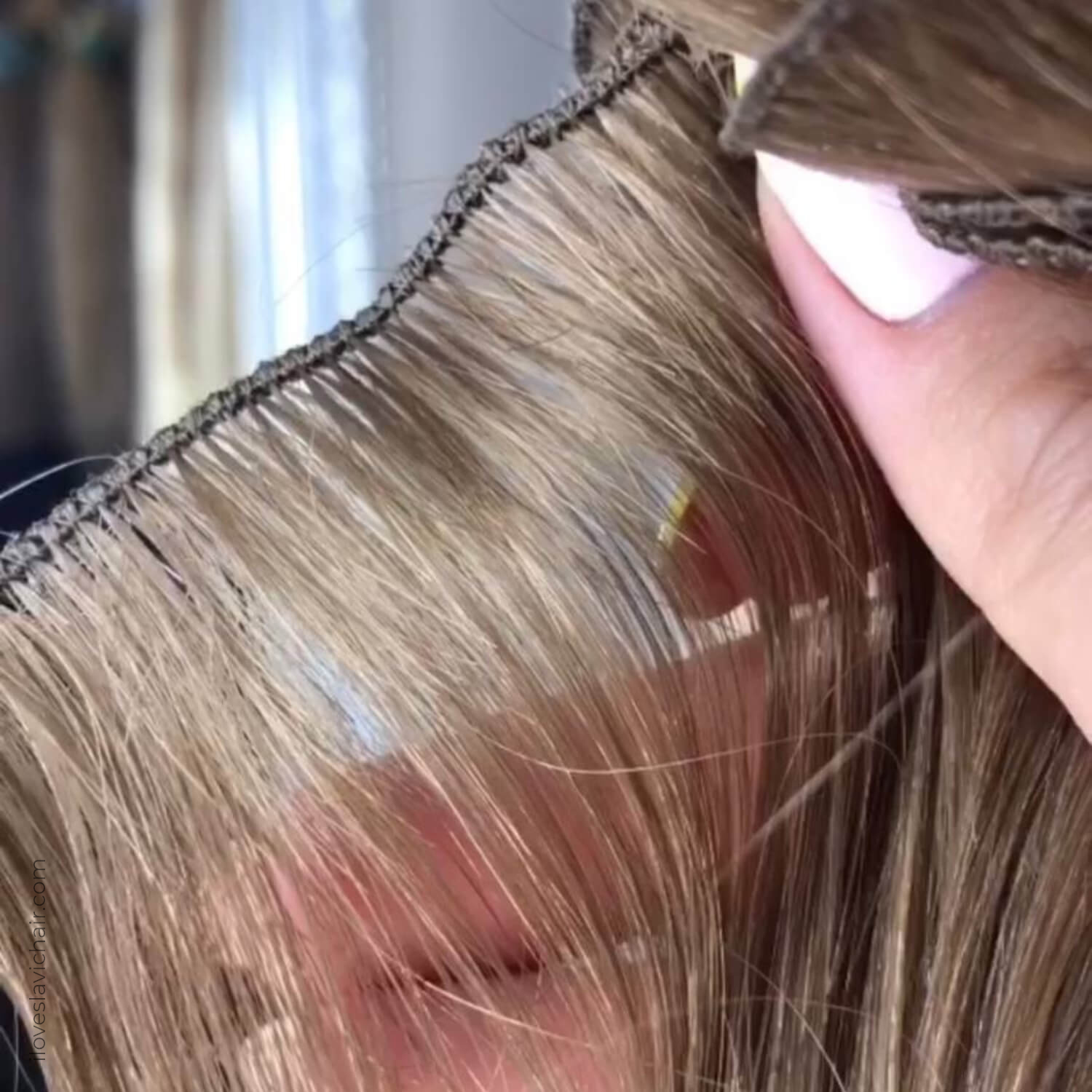
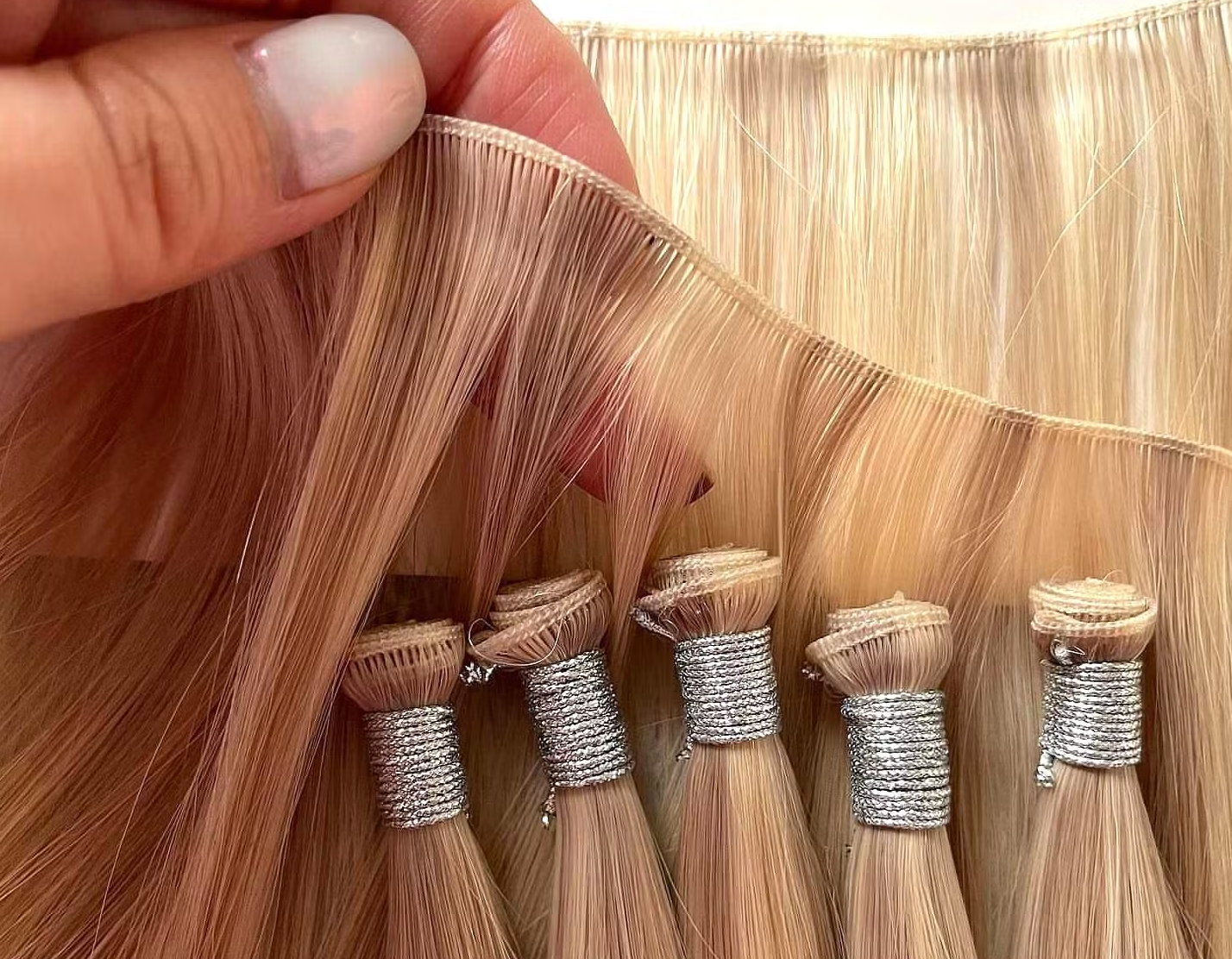
Seam height is the dimension clients feel. On fine hair a 4 mm flat seam reads as a line under the hand, while a 2 mm folded seam disappears into the parting. Width matters just as much: a 90 cm weft cut down to a 30 cm row leaves a raw edge that has to be sealed, and an unsealed cut edge is where shedding starts.
This is the design case behind smaller weft formats. The Genius Weft and the hand-tied weft can both be trimmed to a short row, but only the hand-tied construction keeps a stable edge when cut, because the return stitch holds the ends. Machine wefts need the cut end folded and stitched before installation.
For a client with a 51 cm circumference the side rows are typically 25 to 35 cm wide. If your supplier only ships 100 cm rows, you are paying for hair you will cut away and creating an edge you then have to finish in the chair.
Some combinations should be refused rather than adapted. Tape formats on a client with fewer than about 40 hairs per cm² at the temple will lift within a week, because the adhesive needs surface contact and the tape cannot grip moving scalp. A 50 g row on a 25 cm side section will not sit flat whatever the installer does.
Very fine hair with an active cowlick at the crown generally does better with individual bonds than with any weft, because a weft cannot follow a direction change. That is a construction limit, not a skill limit, and saying so protects the relationship better than a second attempt.
The professional version of this conversation is short: the hair can carry a certain weight, the method has to fit inside that weight, and the ones that do not fit are excluded before the deposit rather than after the first wash.
A specification that a factory can build against has eight fields: method, length, finished weight per row, number of rows, row width, colour code plus tone direction, seam type, and the cut-edge finish. Add the client’s circumference and density band so the next order can be checked against the same head.
Length is measured from the seam to the tip, not from the top of the head. A 20 inch row on a 170 cm client reaches roughly mid-back depending on torso length, so quote length in inches and confirm the drop in centimetres on the fitting.
Colour should be quoted as a code plus a direction, for example a cool ash at level 7, because the same code photographed under warm salon light reads differently to daylight. Every custom order at PLUCHARM is confirmed against the colour ring before production for this reason.
Before committing a client to six rows, order one row in the exact specification. Fit it as the top row, leave it for seven days, and check three things: whether the client can feel the seam through the hair, whether the row edge stays flat when the hair is tied up, and whether the weight at that position is comfortable after a full day.
One row costs a fraction of a full set and answers the only question that matters, which is whether this head can carry this construction. Keep the fitted sample’s specification with the client record. It becomes the reference for every reorder, and it turns a subjective conversation about thickness into a measurement the next order can repeat.
Fine hair is not a smaller version of thick hair. It is a different load case, and the numbers that describe it are grams, centimetres and rows.
Editorial update: 4 November 2026. Gram weights, row widths and seam dimensions described here are PLUCHARM production specifications; confirm the exact specification and commercial terms for your order.
For buyers sourcing at volume, this topic sits alongside the practical detail on our wholesale hair extensions page: the thirteen methods we manufacture, trade pricing and minimum order.